From User Preferences to Movie Recommendations
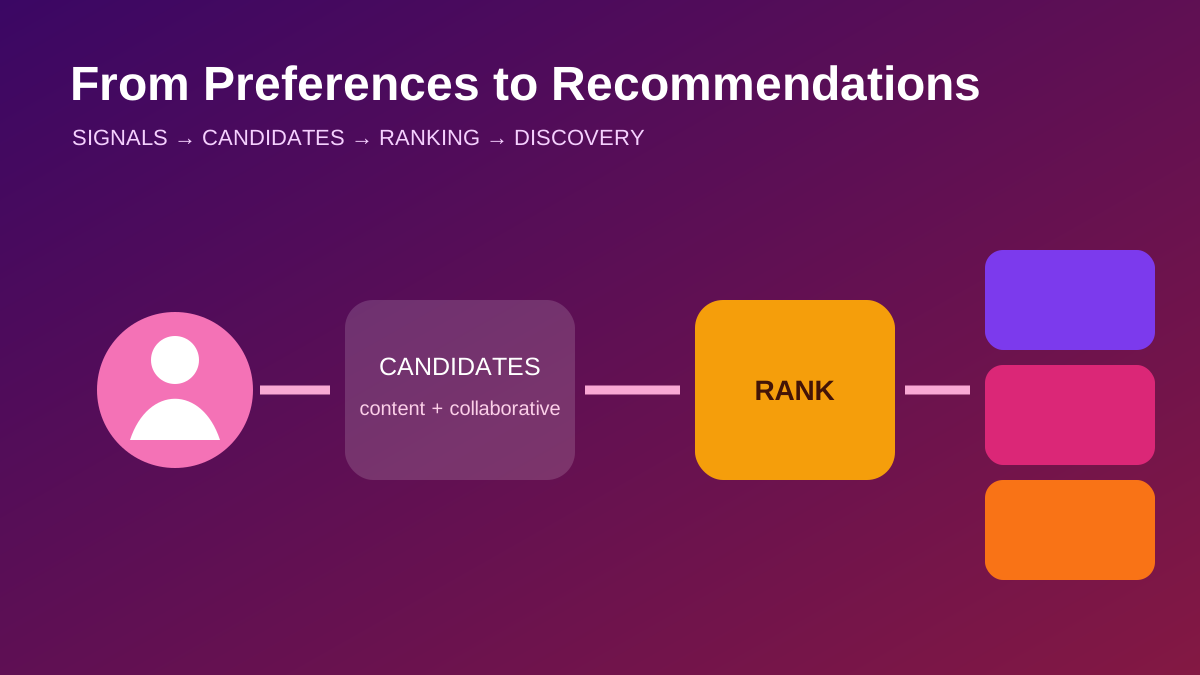
A movie recommender turns scattered signals into a ranked list. The difficult work happens between the user's history and the final cards: deciding which signals to trust, finding plausible candidates, combining evidence, filtering unsuitable results, and explaining the ranking.
Collect Signals with Different Meanings
Explicit ratings are clear but sparse. Likes and favourites show intent, while searches, clicks, watch duration, and completion provide more abundant implicit feedback. A completed film is usually a stronger signal than a poster impression, but even completion can mean the user left the screen running.
Signals need weights, timestamps, and context. Recent behaviour may represent current interest better than a choice from years ago. Shared devices and family accounts make every inference less certain.
Build a Content Profile
A content-based system represents films through features such as genre, cast, director, language, release period, or text embeddings from descriptions. The user's profile aggregates features from positively weighted interactions.
Candidate movies are compared with that profile using a similarity function. This approach can explain recommendations through shared attributes and can work without data from other users. Its weakness is over-specialisation: it tends to recommend more of what the user already knows.
Use Collaborative Evidence
Collaborative filtering looks for patterns across users and items. Neighbourhood methods find users with similar histories or items liked by similar groups. Matrix-factorisation methods learn compact latent representations whose geometry captures interaction patterns.
Collaborative methods can discover connections that metadata misses, but they struggle with new users and new films. They also inherit popularity and exposure bias from historical interactions.
Generate Candidates Before Ranking
Large catalogues are usually handled in two stages. Candidate generation retrieves a few hundred plausible items quickly from several sources: content similarity, collaborative models, trending lists, new releases, or editorial collections.
A ranking model then evaluates those candidates with richer features. Separating retrieval from ranking keeps latency manageable and allows different discovery strategies to contribute to the same list.
Combine Relevance with Product Rules
The final score may combine predicted preference, recency, quality, novelty, and confidence. Filters remove already-watched items, unavailable titles, age-inappropriate content, or languages the user has excluded.
Re-ranking can improve diversity by limiting repeated genres or franchises. These rules should be visible in evaluation because they change the list after the core model produces its score.
Handle the Cold Start
A new user has no history. An onboarding step can request a few favourite movies or genres, but it should remain optional and short. Contextual popularity by language or region provides a fallback, and the interface can deliberately mix safe choices with exploration.
New movies have the opposite problem: metadata is available but interactions are not. Content similarity and editorial placement give them an initial path into candidate sets.
Explain Without Pretending Certainty
“Because you liked…” or “Similar in genre and tone” helps a user understand and correct the system. Explanations should correspond to real ranking evidence rather than being generated after the fact.
Controls such as “not interested,” “show fewer like this,” and profile editing convert explanation into feedback. They also reveal mistakes that offline metrics cannot see.
Evaluate the Whole Experience
Accuracy is one part of the result. Coverage, diversity, novelty, calibration, fairness, latency, and user satisfaction all matter. A useful movie recommender does not merely predict the past; it helps a person make a satisfying next choice.